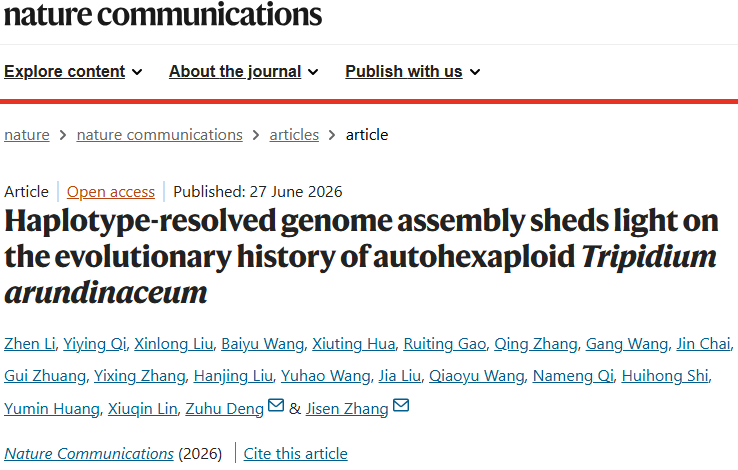
Recently, a research paper titled “Haplotype-resolved genome assembly sheds light on the evolutionary history of autohexaploid Tripidium arundinaceum” was published in the internationally renowned journal Nature Communications by a team led by Prof. Zhang Jisen from the College of Agriculture, in collaboration with Fujian Agriculture and Forestry University and the Sugarcane Research Institute of Yunnan Academy of Agricultural Sciences. Postdoctoral fellow Li Zhen from the College of Agriculture, Ph.D. graduate Qi Yiying from Fujian Agriculture and Forestry University, researcher Liu Xinlong from the Sugarcane Research Institute of Yunnan Academy of Agricultural Sciences, and Ph.D. student Wang Boyu from the College of Life Science and Technology of Guangxi University are the co-first authors of this paper. Zhang Jisen and Prof. Deng Zuhu from Fujian Agriculture and Forestry University are the co-corresponding authors, and Guangxi University is the first completing institution.
As early as 1885, Soltwedel attempted to hybridize Tripidium arundinaceum with sugarcane in sugarcane breeding research, an exploration that was almost simultaneous with the “nobilization” breeding based on Saccharum spontaneum. Subsequently, sugarcane breeding institutions in Barbados, Hawaii, Louisiana (USA), and South Africa successively carried out related research, but most remained at the stage of obtaining F1 generation materials. Although a few sugarcane varieties have introduced Tripidium arundinaceum bloodlines, their application in production has been limited and has not achieved large-scale promotion. Overall, how to effectively utilize Tripidium arundinaceum germplasm resources has always been a key scientific issue for expanding the genetic base of sugarcane. The wild genetic background of currently cultivated modern sugarcane varieties still mainly originates from Saccharum spontaneum, with a relatively narrow genetic base.
This study, for the first time, constructed a high-quality, haplotype-resolved genome of Tripidium arundinaceum—a wild relative of sugarcane—confirming its evolutionary status independent of the Saccharum genus at the whole-genome level, and systematically revealing its polyploidization history, population genetic diversity, and climate adaptation mechanisms, providing important genomic resources for the utilization of wild sugarcane germplasm resources and stress-resistance breeding. This achievement represents another important progress by Prof. Zhang Jisen’s team in this field, following a series of representative achievements including those published in 2018 (Zhang et al., Nature Genetics), 2022 (Zhang et al., Nature Genetics), 2023 (Wang et al., Nature Plants), 2025 (Zhang et al., Nature Genetics), and 2026 (Huang et al., Science), within the systematic research chain of “sugarcane genome analysis—germplasm resource evolution—polyploid genome research methods—mining of genes with major breeding value” that the team has established around the main theme of sugarcane biobreeding.
This research was funded by the National Key R&D Program of China, the National Natural Science Foundation of China, the Guangxi Science and Technology Major Project, the Guangxi Bagui Scholar Talent Support Program, the China Postdoctoral Science Foundation, and the National Funded Postdoctoral Researchers Program.

 Address: No.100,East Daxue Road,Xixiangtang District,Nanning, Guangxi,China
 Postal Code: 530004
 Tel: 86-771-3238863
 Email: gjc@gxu.edu.cn